 Despite the considerable critical praise, I approached Lauren Groff’s third novel with some trepidation. I felt exhausted from the outset by the prospects of another study on the vicissitudes of upper middle class Manhattanite matrimony. I was mistaken. Rather than wallowing in the banal realism that would characterize a lesser work of fiction (characters moving from optimism to set-backs, parenthood to infidelity and divorce, somber old age), Fates and Furies is a far darker narrative, made especially ominous by parenthetical voices that interrupt the narrative in spasms to offer brusque commentary, shed light on interior motives, and cast fortunes for our two protagonists, Lancelot (“Lotto”) and Mathilde Satterwhite.
These cold interpolations belong to the ancient narrators invoked in the novel’s title: the Moirai (Fates) and the Erinyes (Furies). They recite chilly morals: “Grief is for the strong, who use it as fuel for burning.” They are callous, as when reflecting on fireworks at a Fourth of July party: “Doomed people celebrate peace with sky bombs.” Their omnipotence means that nothing is off limits to the reader, in one instance extending even into the mind of a cat. Most brilliant is a scene in which Lotto, Mathilde, and a chorus of family and friends sing carols round a Christmas tree, catching the attention through their window of a passerby from the street, who will hold onto the image for the rest of his life: “All those years, the singers in the soft light in the basement apartment crystallized in his mind, became the very idea of what happiness should look like.”
The novel is read as two books. Fates tells the story of the husband Lotto, his childhood, teen years, and his married life with Mathilde. Furies resets the plot and reexamines many of the same events from Mathilde’s perspective, while also filling in the gaps of her own childhood. Lotto is an innocent narcissist, self-defeatist but favored by the Fates and everyone who meets him. In her own narrative, Mathilde, whose life was shaped by a fatal event in early childhood, unsheathes the fury at her core and shocks the reader.
For all of its stylistic tricks, Fates and Furies never feels gimmicky. The prose is florid but not self-indulgent.The abundant references to canonical Western literature are employed meaningfully and not as pretentious accouterments. The writing does not strain for eloquence or profound ontological insight. They come naturally. While the novel is grounded in traditions dating back to antiquity, it still manages to say something new and revelatory about the meaning of human existence. In so doing, Groff performs two subversive feats. First, the narrative challenges the primacy of free will in the Judeo-Christian worldview. Agency is axiomatic in modern thinking, but the Ancient Greek cosmology was ordered by a strong theological determinism—after all, even the gods of Olympus could not unspool the weaving of the Fates. Second, Mathilde is emblematic of what might be considered a new trend in fiction: the literature of female rage. Elena and Lila, heroines of Elena Ferrante’s Neapolitan Novels, belong to this same class. In these worlds (almost always acutely domestic), women suffer many indignities and are rarely recognized for their abilities, but their yielding exteriors mask an almost animalistic will to survive. Self-immolation is not in the cards. Mathilde would sooner poison Monsieur Bovary or push Karenin in front of the train.
 In November 2016, Knopf published David France’s How to Survive a Plague: The Inside Story of How Citizens and Science Tamed AIDS. While I certainly intend to read the book, my nightstand is currently overflowing with volumes. In the meantime, I opted to watch France’s documentary by the same title, which preceded the book by four years and inspired its publication.
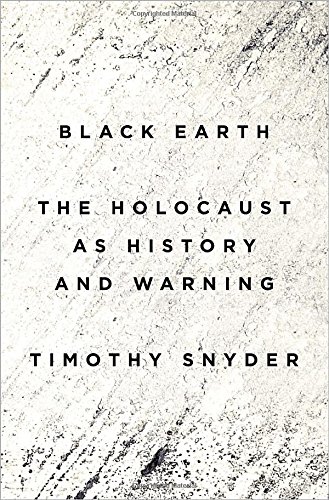 Timothy Snyder’s history of the Holocaust is situated within the framework of his academic speciality: (post)modern Eastern Europe. Snyder’s previous work of popular history, Bloodlands: Europe Between Hitler and Stalin (2013), focused on the hellish reality of Eastern European countries caught between two mass murdering empires in WWII. Black Earth can be read as an extension of that project, only from the perspective of the 5.5 million Jews murdered by Germany in the stateless zones of Eastern Europe. Perhaps unavoidably when one considers the tangled history of the states in question, the reader risks getting lost in the minutia of rival political parties, internal schisms, disputed borders, and ancient ethnic prejudices. Yet despite the expository density, the central tenets of the book are repeated frequently and clearly enough to be condensed easily.
 Suffering turns us into egotists, for it absorbs us completely: it is later, in the form of memory, that it teaches us compassion.
 Man vs. Books